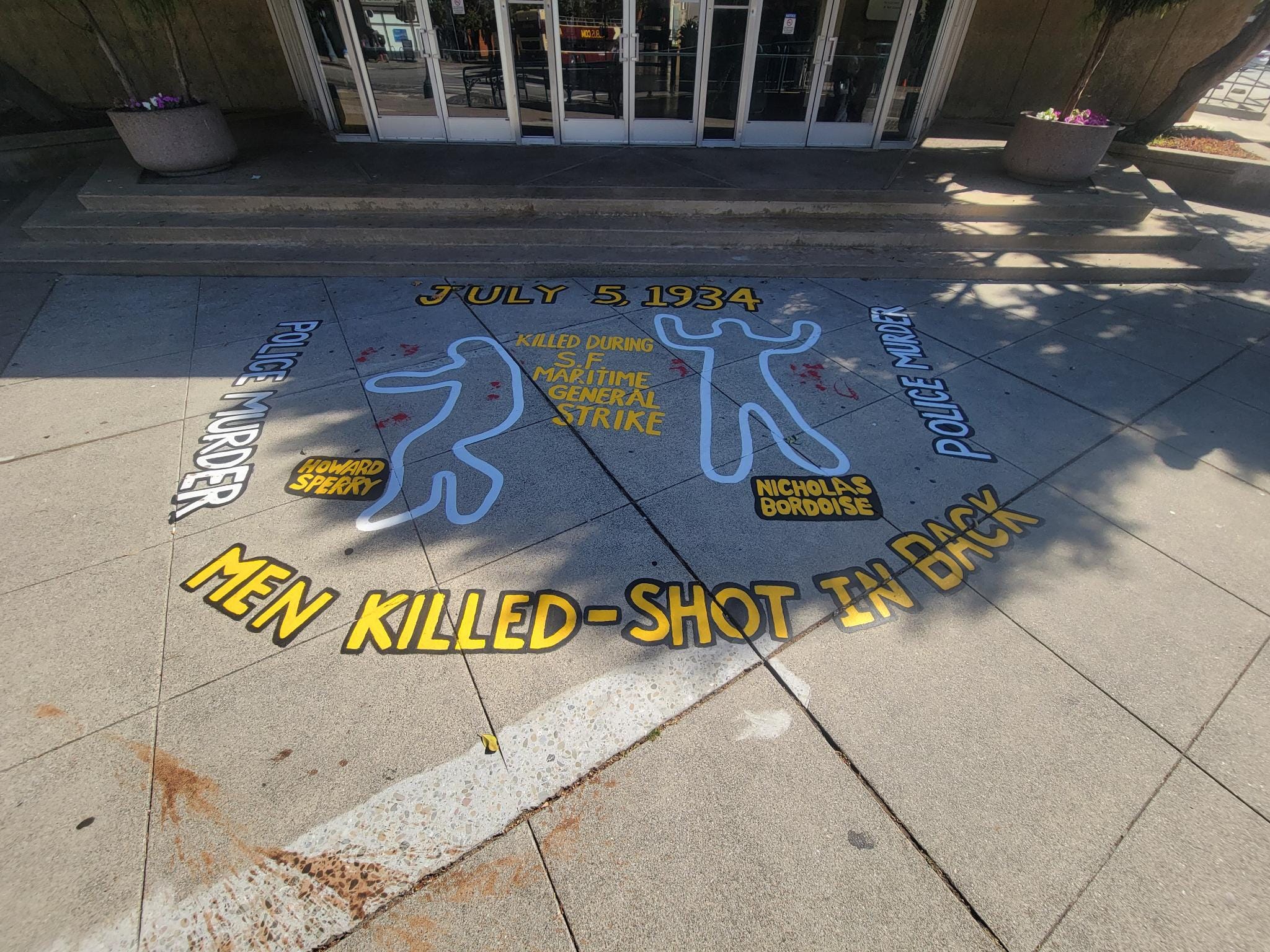
Bloody Thursday
San Francisco, July 1934.

There is an ATM at the Longshoremen’s Hall on Beach and Mason Streets that I use because it doesn’t charge a fee. It is unremarkable. The hall is unremarkable. The street is full of tourists headed to Fisherman’s Wharf, which is a few blocks west and aggressively remarkable, in the way that places designed to extract money from people tend to be.
I live at Pier 39. I walk past this hall regularly. I have used this ATM untold times.
It took me longer than it should have to notice the memorial.
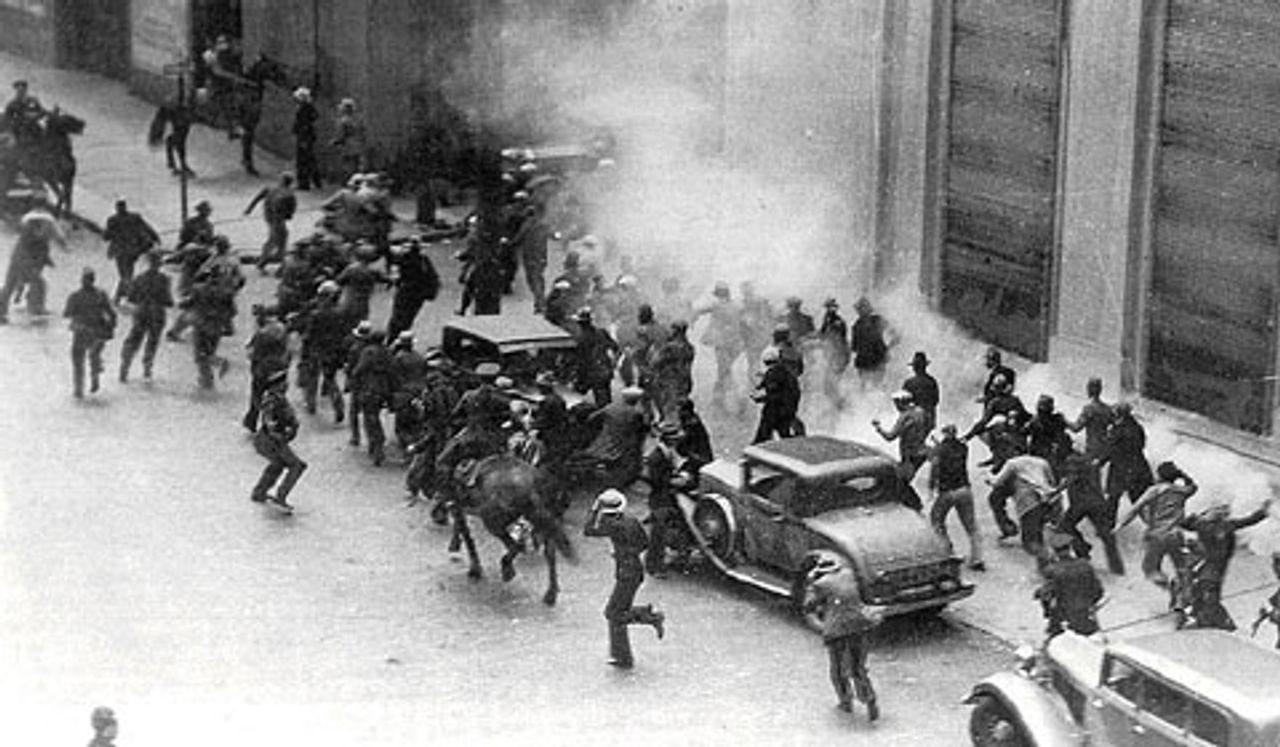
On July 5, 1934, the San Francisco Police Department opened fire on striking longshoremen on the Embarcadero. Two men died. Dozens were wounded. The day is called Bloody Thursday, and it is the reason San Francisco shut down completely eleven days later in the only general strike an American city has ever seen.
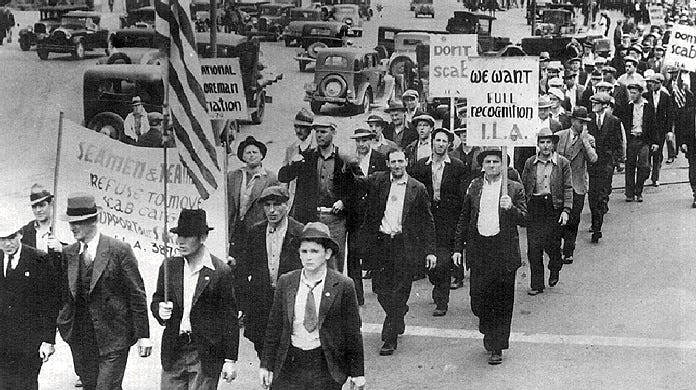
The background: the International Longshoremen’s Association had been on strike since May 9. The grievance was simple. The port was controlled by the Industrial Association, a cartel of shipping companies that ran hiring halls where workers showed up each morning and waited to be selected, or not selected, for work — a system designed to keep men desperate, replaceable, and non-union. The ILA wanted union-controlled hiring. The companies said no.
For nearly two months the waterfront was paralyzed. Harry Bridges, a wiry Australian immigrant who had come to San Francisco as a merchant seaman and stayed, was running the strike. The employers called him a Communist. He called the employers thieves, and had the better argument.
On July 3, the Industrial Association announced it was reopening the port. On July 5, they sent trucks down the Embarcadero.
The strikers were waiting for them.
What followed was hours of street fighting — rocks, clubs, bricks, tear gas. The police charged the picket line repeatedly. By afternoon they were firing live rounds and shotguns into the crowd.
Howard Sperry was a longshoreman and a veteran. He was shot in the back while trying to help a wounded man. He died on the pavement near Rincon Hill.
Nick Bordoise was a cook and a member of the International Workers of the World. He was there to run the strikers’ soup kitchen. He was shot while kneeling over another wounded man. He died the same day.
Two men. Killed by police, on American soil, for striking.
The governor of California called it an “insurrection” and deployed the National Guard. The Industrial Association declared victory. The port reopened.
They had badly miscalculated what comes after you shoot people.
On July 9, the funerals were held. The bodies of Sperry and Bordoise were placed on flatbed trucks and driven down Market Street. An estimated 40,000 people lined the route. The city was silent. No one threw anything. No one shouted. People stood at the curb and watched the trucks pass in complete quiet, which is louder than any riot.
Harry Bridges stood at the head of the march in a dark suit.
The International Longshoremen’s Association, the Teamsters, and then virtually every other union in the city voted to strike in solidarity. On July 16, the General Strike began. The city stopped. Restaurants closed. Retail closed. Streetcars stopped. Gas stations closed. Hotels ran out of food. For four days, San Francisco was a city in which nothing moved except the National Guard and the journalists filing increasingly panicked dispatches about the imminent Communist revolution.
There was no Communist revolution. There was a labor negotiation.
By July 19 the General Strike was over. The longshoremen held out until October, when the dispute went to federal arbitration. The arbitrator ruled largely in the union’s favor. Union hiring halls replaced the company halls. The men who showed up at the docks each morning would now be dispatched by their own union, not selected by the companies that employed them.
It was not a revolution. It was a hiring hall. Two men died for a hiring hall.
Harry Bridges ran the ILWU — the International Longshore and Warehouse Union — for the next four decades. The federal government tried to deport him four times on charges of Communist affiliation. They failed four times. He died in San Francisco in 1990, age 88.
The memorial at Beach and Mason is modest. It does not demand your attention. Neither does the ATM.
Most people walking to Fisherman’s Wharf don’t know that ninety years ago this city shut itself down completely over two dead men on the waterfront. They don’t know what a hiring hall is, or why anyone would die for one. They don’t know that the quiet of July 9, 1934 — 40,000 people lining Market Street without a sound — was one of the loudest things this city has ever done.
The hall at Beach and Mason was built in 1959, fifteen years after Bloody Thursday, by the union that won. In 1965 it became something else entirely: the Family Dog threw their first dances here, the ones that started the San Francisco acid rock scene. The Grateful Dead played the Trips Festival in this building in January 1966, with a custom Buchla synthesizer and ten speakers ringing the balcony.
The longshoremen who died for a hiring hall got a building. The building hosted a revolution they would not have recognized.
I use the ATM. It still doesn’t charge a fee.