
The Great Egg War
Sometimes you gotta shoot a few guys to make an omelette.

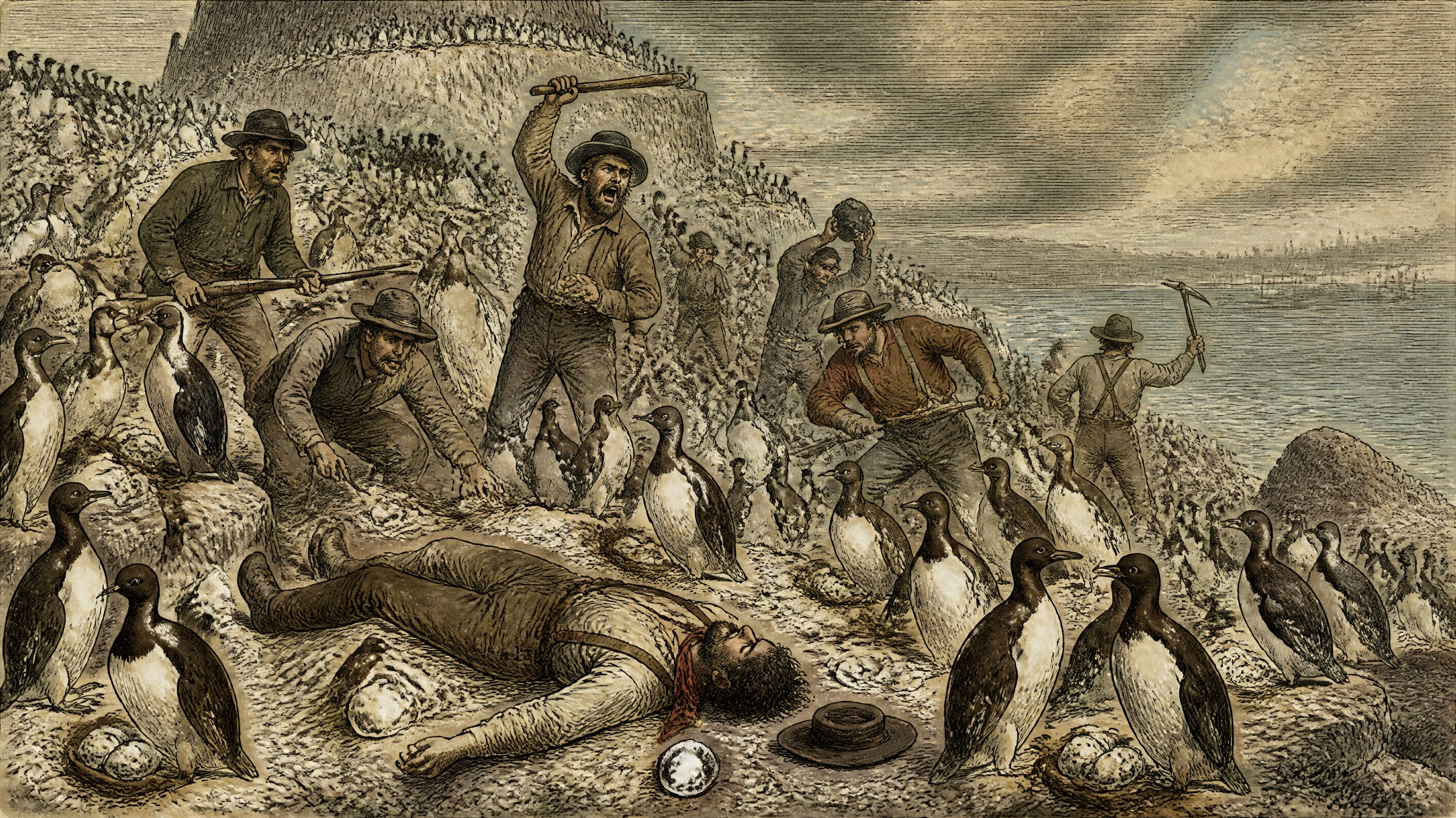
In the summer of 1863, twenty-seven armed men rowed ashore on a rocky island twenty-five miles off San Francisco in three boats, and were immediately shot at by the men defending the island’s eggs.
This is a true sentence. This happened.
The Farallon Islands are visible from the city on a clear day — a smear of rock on the horizon that the Pacific seems to be in the process of swallowing. They are inhospitable in the way that places are inhospitable when no one intended for people to be there: no fresh water, treacherous approaches, wind that doesn’t stop. The Ohlone who lived across the bay believed the islands were where the spirits of the dead went, and declined to visit. Several ships sank trying to land there in a single decade. The wildlife, by contrast, is fine. Half a million common murres breed there every year, stacking into colonies on the rock faces and laying their eggs.
One egg per season. Destroy it, and the bird lays another.
This was, in 1849, extremely useful information.
The immediate problem was that San Francisco had 25,000 people in it, most of whom had arrived within a single year, and the city had almost no chickens. Getting rich in California did not involve raising chickens. The men pouring in from the eastern states, from Chile, from China, from Australia, had come for gold, and as a consequence an ordinary hen egg cost $1 apiece in 1849 San Francisco. One dollar. Per egg. You could buy a building lot in most American cities for what a dozen eggs would cost you at a San Francisco market.
A man known only as “Dr. Robinson” — a recent immigrant, his actual first name apparently not considered worth preserving by history — sailed out to the Farallones that year. He’d heard about the murres. He loaded a boat with eggs. He lost half his cargo on the rough crossing back across the Golden Gate. He still made enough money to found a pharmacy and start a company.
The Pacific Egg Company. Sometimes called the Farallon Egg Company. The name changed over its history, the way business names do when the partners have arguments, but the operation stayed the same: send men to the islands every season from mid-May through July, collect as many murre eggs as possible, bring them back to San Francisco, sell them.
At peak, the operation could yield 500,000 eggs a month.
Egg picking was a specific kind of work that required a specific kind of man. You had to scramble over rock faces covered in nesting seabirds, work fast enough that the gulls didn’t steal the eggs before you did, and do all of this in the middle of a colony of birds that objected to your presence in the most direct terms available to birds.
What made it profitable was the smashing.
When the eggers arrived at a colony, before they collected a single egg, they walked through the entire area and destroyed every egg they could find. Crushed them underfoot. Smashed them against rocks. Every single one. This took time and effort and is one of the more deliberately horrible things a person can do on a Tuesday morning, but it had a logic: if all the old eggs were gone, any egg you found on the way back through was freshly laid. No chance of selling a San Francisco customer a murre egg with a half-developed chick inside it. Quality control through industrialized destruction.
The common murre, to recap, lays one egg per season. Destroy it, and the bird lays another. The eggers relied on this. The birds had no choice. The eggers had no complaints. The company was making money.
The problem, as tends to happen when a lot of money is concentrated in one place, was that other people also wanted some of it.
The Egg Company had surveyed the islands, obtained a land warrant, built structures, and put in landing facilities. They claimed the islands. The federal government, inconveniently, also claimed the islands — President James Buchanan issued an executive order in 1859 asserting federal ownership for the purpose of the lighthouse that had already been built there in 1855. The lighthouse superintendent of the area, a man named Ira Rankin, chose to resolve this conflict by deciding that the Egg Company had the right to the eggs, and that rivals did not.
This was the arrangement in place when David Batchelder showed up.
Batchelder was running a competing egg operation. He tried to land on the main island. Rankin’s armed men turned him away. He came back. They evicted him again. On June 2, 1863, Batchelder returned once more and convinced Rankin that this time he was only going to egg the smaller North Farallones, which the Egg Company hadn’t claimed. Rankin’s men left for San Francisco.
Two days later, on the morning of June 4, three rowboats with twenty-seven armed men tried to make landfall.
The Egg Company’s defenders had chosen their positions ahead of time. They opened fire as the boats hit shore. Batchelder’s men returned fire. After twenty minutes, Batchelder’s force retreated. One man was dead on each side. Four of Batchelder’s men were wounded.
David Batchelder was convicted of murder.
He was then acquitted on a technicality.
The Egg Company retained sole control of the Farallones. They operated for another two decades. The federal government finally evicted all the egg companies from the islands in 1881, by which point the murre population had been systematically harvested for thirty years and was not in good shape.
The common murre has since recovered. There are again roughly half a million of them on the Farallones. The islands are a National Wildlife Refuge now, closed to the public.
Nobody is selling their eggs in San Francisco anymore, though the current price per dozen would not strike a forty-niner as unreasonable.
Source: Peter White, The Farallon Islands: Sentinels of the Golden Gate (Scottwall Associates, 1995).