
The Monkey Block
The most interesting building San Francisco ever had.

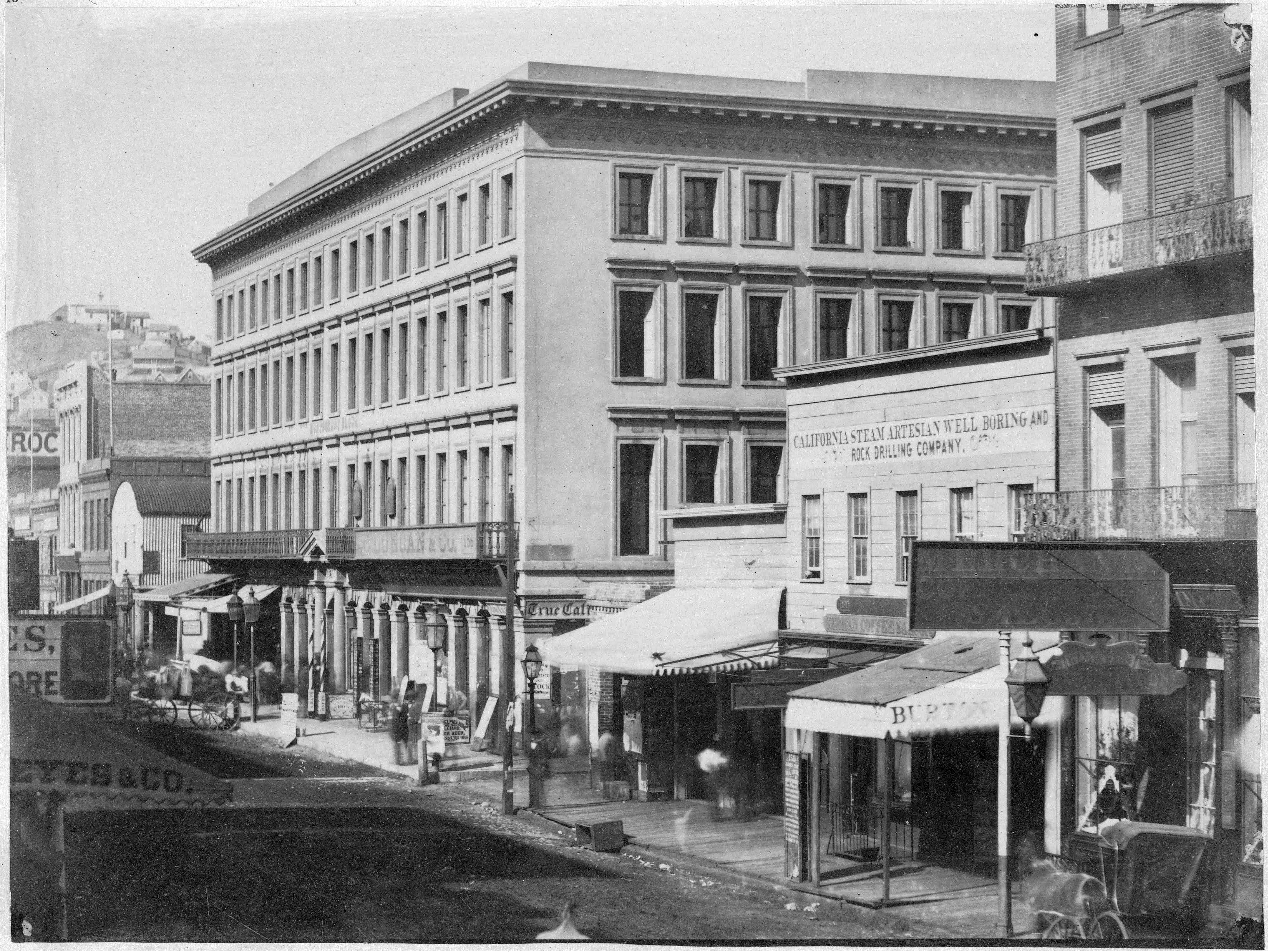
San Francisco buries its past under asphalt and calls it progress.
There’s a spot where Columbus Avenue dead-ends into Montgomery Street — or rather, doesn’t quite dead-end, just kind of gives up and dissolves into the intersection at an angle that doesn’t make sense until you realize it’s following the old shoreline. Up until sometime around 2005, you could look past the sidewalk there and see down into it: the actual shoreline, exposed underneath the street like a dry creekbed under a bridge. The city had just built over it and kept going. I worked four floors up at 655 Montgomery for a few years, and I walked past that gap every day without thinking much about it. I thought about it more later.
The Transamerica Pyramid is right there. You probably know it. Forty-eight floors of white concrete, the most recognizable building in the San Francisco skyline, opened in 1972. It is aggressively corporate. It is also, if you know what you’re looking at, a tombstone.
What’s buried under it is the Montgomery Block.
The building went up in 1853, four years after the Gold Rush turned a mudflat into a city. Henry Halleck — later a general in the Civil War, at the time a San Francisco lawyer with an engineering background — built it on a raft of redwood logs floated over the bay mud. Four stories, an entire city block, the largest building west of the Mississippi. Everyone told him it would sink. It didn’t.
It also didn’t burn.
In 1906, the earthquake hit and then the fires came. Everything around the Montgomery Block went — the wooden Victorians, the hotels, the banks. The Block survived. The floating foundation flexed with the ground instead of cracking. Afterwards, people sheltered there. The basement baths were turned into a makeshift hospital. The city that burned rebuilt itself around the building that didn’t.
For a hundred years the Montgomery Block was where you went if you were interesting and broke. In San Francisco, that has always been most of the interesting people.
Mark Twain used to drink there. Bret Harte wrote there. Ambrose Bierce, who was constitutionally unpleasant and widely considered the best writer in California, kept an office there. Robert Louis Stevenson worked in the basement. Jack London argued with everyone.
In 1911, a man named Sun Yat-sen took room 305. He was planning a revolution — the actual overthrow of the Qing Dynasty and the founding of the Republic of China. He raised money, coordinated with overseas Chinese communities up and down the coast, ran his operation out of that room on Montgomery Street. The revolution happened. He went home to run it. The Montgomery Block is where it started.
Diego Rivera painted murals in the building in the 1930s. The murals are gone now.
The Block lasted through the Gold Rush, the earthquake, two world wars, and the Depression. What it couldn’t survive was 1959.
That’s when they tore it down.
For a parking lot.
I want to be careful here not to editorialize too heavily, because the facts are doing enough work on their own: the building where Mark Twain drank and Sun Yat-sen planned a revolution and Diego Rivera painted murals survived a century of San Francisco history and was demolished to provide parking for the Financial District. It sat as a parking lot for thirteen years. Then they built the Pyramid.
I walked past that gap in the pavement every morning for a couple of years. The bay used to come right up to there — before the landfill, before the streets, before any of it. The Monkey Block was built on logs floating over what used to be water. The Pyramid is built on the bones of the Monkey Block.
San Francisco will tell you it loves its history. It puts up plaques. It names parks after people. It is very sincere about this.
What it actually does is pave over the things it can't monetize and build something shiny on top. The gap was there until around 2005, and then it wasn't. Most people never noticed either way.
The Transamerica company sold the building in 2020. A German pension fund bought it for $650 million, spent another $250 million renovating it, and sold it last March at a loss to Yoda PLC, a Cyprus-based firm with Greek and Israeli ties, which borrowed $300 million from a bank in San Diego to close the deal.
The building where Sun Yat-sen planned a revolution is currently owned by nobody who has ever lived here.