
Three Days to Light a Fire
I want to turn this information into a TikTok someday, like how to start a Humvee.

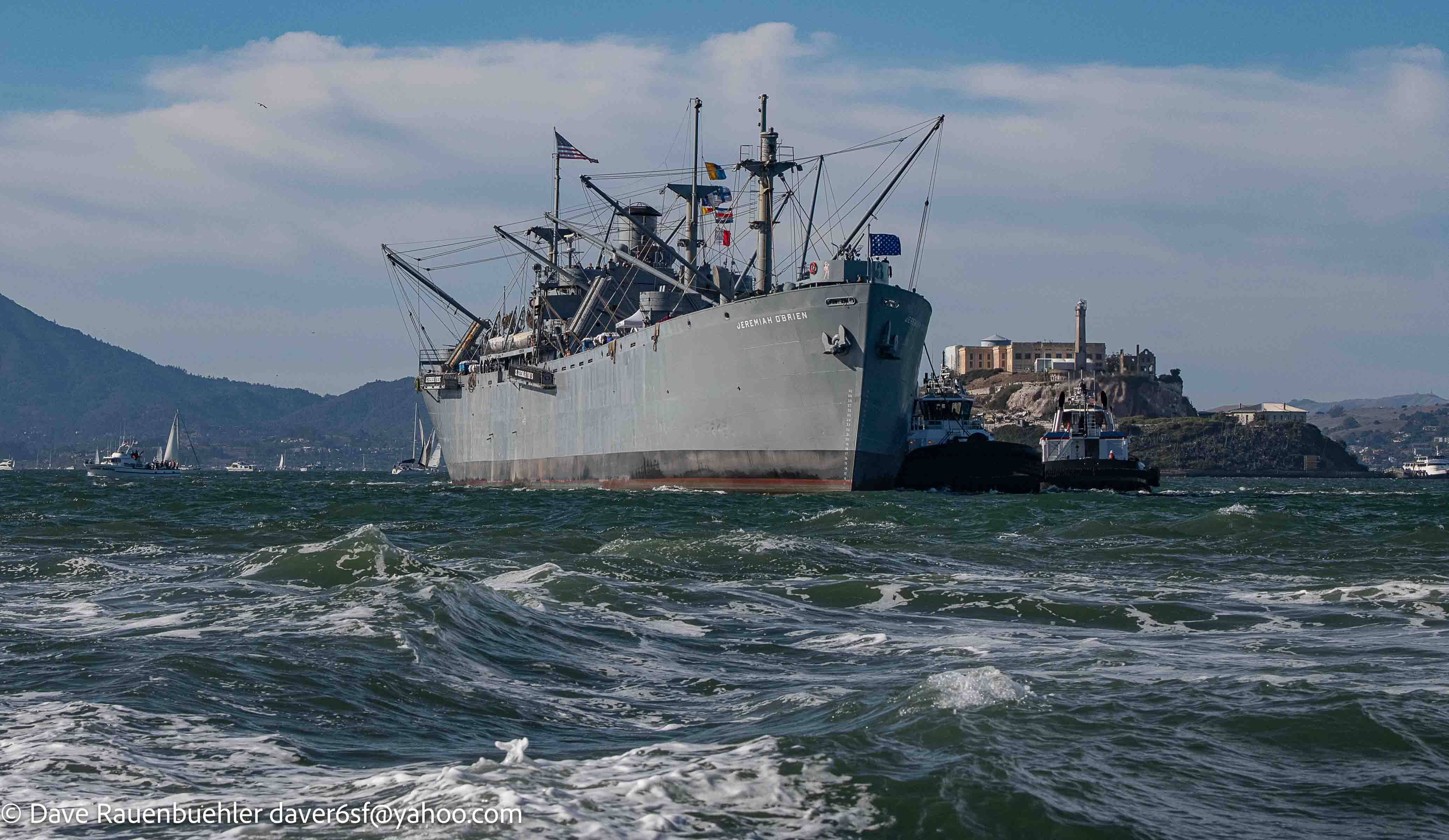
I’ve been spending a lot of time lately at Pier 35 doing things that would probably make no sense to explain to most people.
“What are you doing this weekend?”
“Going down to the ship to watch engineers put a three-story steam engine back together while arguing about cable and valves.”
Right. So.
The SS Jeremiah O’Brien is berthed at Pier 35 in San Francisco. She’s a WWII Liberty ship — one of 2,710 built in a four-year sprint between 1941 and 1945 to keep Britain alive and then storm the beaches of Normandy. Two of those ships survive as operational vessels. She’s one of them. Every year around Memorial Day, we take her out on the bay. Getting her ready for that starts this Tuesday, and it’s not a simple process.
The reason it’s not simple is sitting in her engine room: a triple-expansion reciprocating steam engine, 135 tons of iron and steel, built by the General Machinery Corporation of Cincinnati, Ohio. It makes 2,500 horsepower at 76 RPM. It was designed in the Victorian era, and the O’Brien’s has been running continuously — with appropriate maintenance — since 1943.
You do not just turn this thing on.


Day One: Lighting Off
The process starts with the boilers, not the engine. The O’Brien has two Scotch marine fire-tube boilers, and they’ve been sitting cold since the last time she steamed. Cold means cold — metal that’s been sitting in San Francisco bay air, not warm, not even slightly pressurized. Getting from that to 220 PSI of live steam takes patience that most people in 2026 have completely forgotten how to have.
Before you light anything, you’re doing pre-checks. All the main steam valves have to be confirmed closed. Feed water valves open. You fill the boiler to just below normal water level — but carefully, because if the temperature difference between the boiler metal and the feed water is more than about 50 degrees Celsius, you fill it very slowly or you risk thermal shock on metal that’s more than 80 years old. There’s nobody manufacturing replacement boiler drums for Liberty ships. You treat what you have with respect.
Once you have water, you light the burners on manual control at minimum load. And then you wait. You’re not trying to make steam yet — you’re just warming the metal. Evenly. Gradually. The refractory lining inside the firebox needs to come up to temperature slowly or it’ll crack. Old boilers are like old people: they don’t like being rushed and they’ll let you know if you push too hard.


There’s a water level gauge on each boiler that you’re watching constantly during this phase. As the water warms, it expands. You have to drain some off or the level gets too high. You’re also watching for steam — when it first starts to appear at the air vent on top of the boiler, that tells you you’ve reached 212 degrees Fahrenheit. You close the air vent. Pressure starts to register on the gauge. It’s going to take all day to get where you need to be, and that’s fine, because you have two more days.
Day Two: Building Pressure
By the second day you’re working the boilers up toward operating pressure. For the O’Brien that’s 220 PSI. The whole time you’re doing this, you’re also warming up the steam lines — the pipes that carry steam from the boilers to the engine. You can’t just blast hot high-pressure steam into cold steel pipe; you open bypass valves first, let the steam in slowly, let the condensate drain out, wait for the metal to warm up before you open the main valves.
This matters because condensate in a steam line is dangerous. Steam moves fast. If it hits a pocket of water, that water doesn’t compress — it goes somewhere else, fast, and it takes the pipe with it. Water hammer in a steam system is not a theoretical concern. So you drain, you wait, you check, you drain again.


The engineers doing this work are volunteers. Most of them are retired mariners or marine engineers. Some of them worked on ships like this when they were new — which means they are, to put it gently, not young. Watching them move through the engine room is like watching people speak a language that stopped being taught in schools fifty years ago. They know where every valve is without looking. They know what a given gauge is supposed to read at a given point in the startup sequence. They know what sounds wrong.
I do not have this knowledge. I stay out of the way and document.
Day Three: Turning the Engine
This is the part that looks like something from a movie, which I say as someone who is usually skeptical of things that look like something from a movie — and also as someone who can tell you that this engine literally is in a movie.
James Cameron used the O’Brien’s engine room for the Titanic. That scene where the engine room crew throws the engine into full reverse as the ship bears down on the iceberg — that’s this engine, on this ship, out on San Francisco Bay, doing the same maneuvers the Titanic actually did. Cameron needed a real triple-expansion reciprocating engine because there isn’t a prop in the world that looks like one running under load. So he came to Pier 35.
I think about that every time someone describes the O’Brien as a museum piece.
Before you run the triple-expansion engine under load, you have to warm it up and clear condensate out of the cylinders. The engine has three cylinders arranged fore to aft: High Pressure, Medium Pressure, and Low Pressure. The HP cylinder gets steam first, expands it, exhausts into the MP, which expands it further and exhausts into the LP, which wrings out the last energy before the steam goes to the condenser. Each cylinder has a drain cock. You open them all.
Then you rock the engine. Slowly, by hand — or rather by using the starting controls on the gauge board — you send a little steam in, turn the engine over a fraction, let condensate drip out of the drain cocks, reverse, do it again. The crank sequence runs HP-LP-MP, so the big flywheel turns in a specific order. You’re also watching for any cylinder that sounds wrong — a knock, a thud, anything that suggests liquid in there that shouldn’t be. Steam compresses; water doesn’t. A water slug in a moving cylinder is how you break things that can’t be replaced.
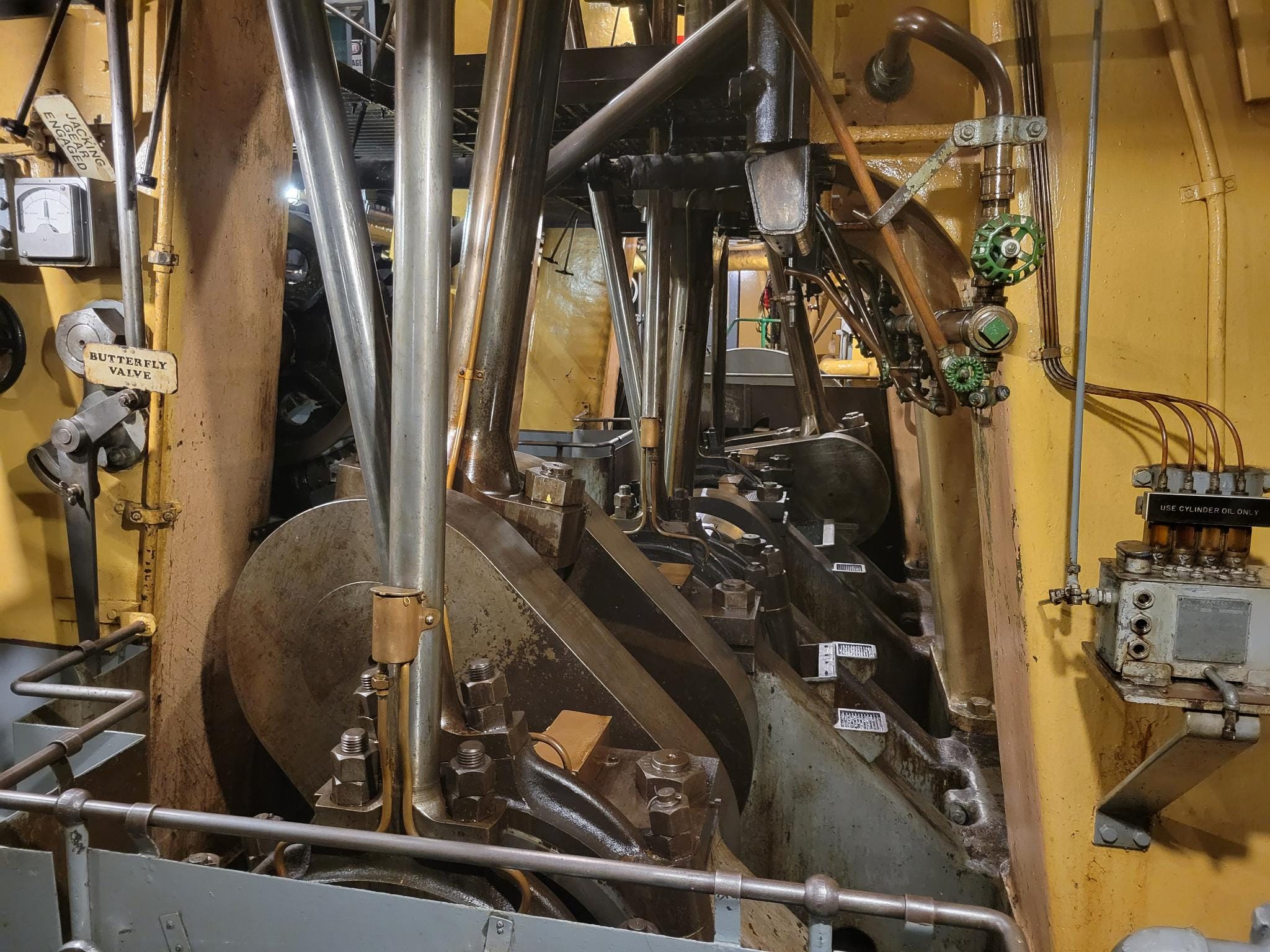
Once you’ve satisfied yourself that the cylinders are clear and the engine is warm, you bring the steam up, close the drains, and let her run. At full speed she turns 76 RPM, which sounds slow until you’re standing next to a 135-ton engine doing it. The whole ship feels different when she’s running under power. The deck vibrates differently. You can feel it in your feet.
Saturday, May 30
We leave Pier 35 at 10 AM.
If you’ve never been on the O’Brien while she’s steaming, I would genuinely recommend figuring out how to be on her while she’s steaming. There are still tickets available for the Memorial Day cruise. The ship doesn’t pretend to be a museum — she is an operational vessel crewed by volunteers who know what they’re doing, and the experience of being aboard while that triple-expansion engine is turning is something that doesn’t exist in many other places on earth.
The work to make that happen starts Tuesday at the engine room. I’ll be there with a camera.
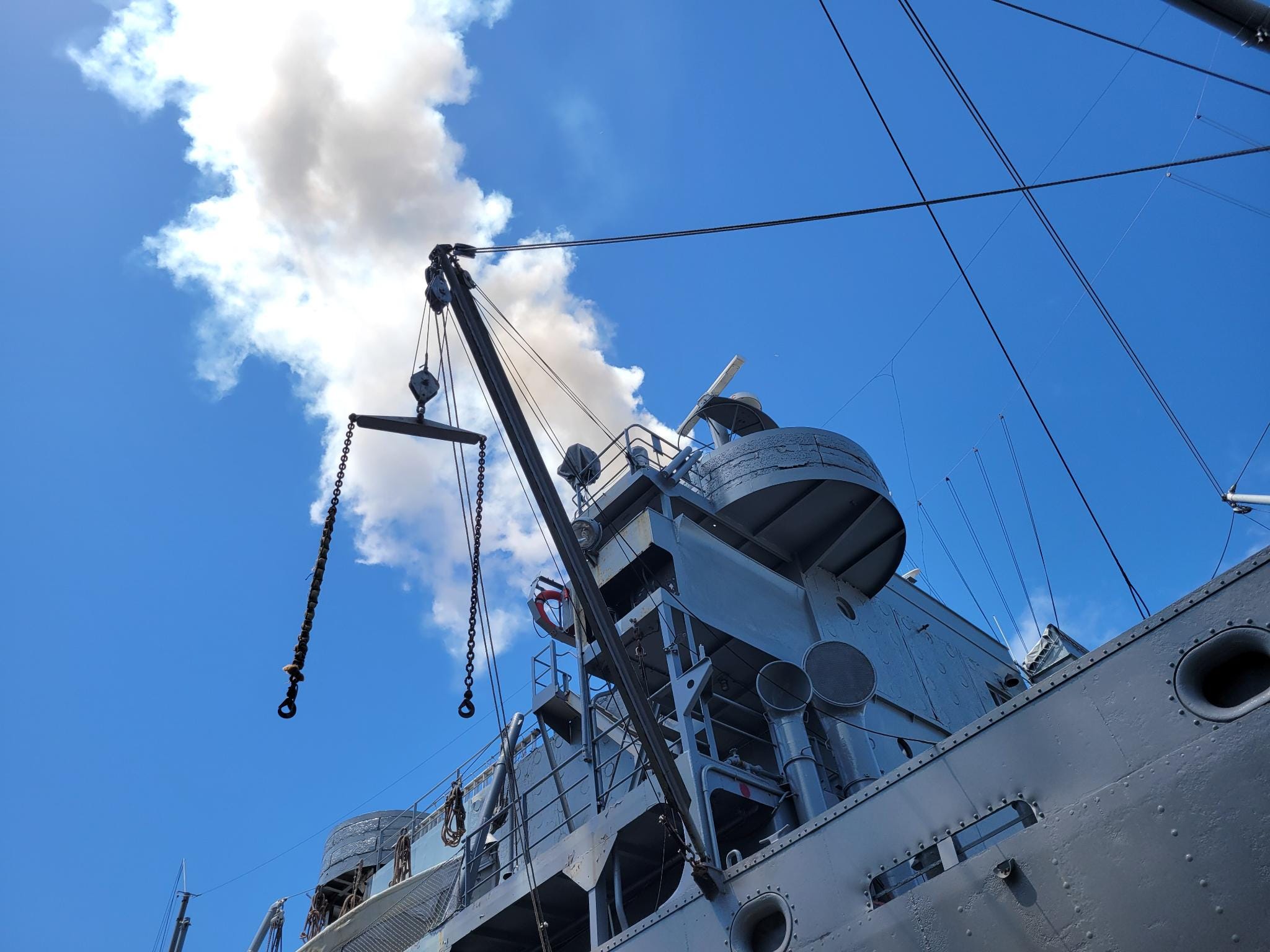
Tickets and information at ssjeremiahobrien.org.